24/7 Emergency AC Repair & Air Conditioner Restoration
Emergency AC repair provides 24/7 immediate on-call technician dispatch for air conditioning breakdowns, compressor humming, blown dual run capacitors, and refrigerant leaks.
Certified EPA Section 608 technicians arrive in fully equipped mobile service vans within 15 to 30 minutes, carrying universal replacement parts to restore ice-cold airflow on the first visit.
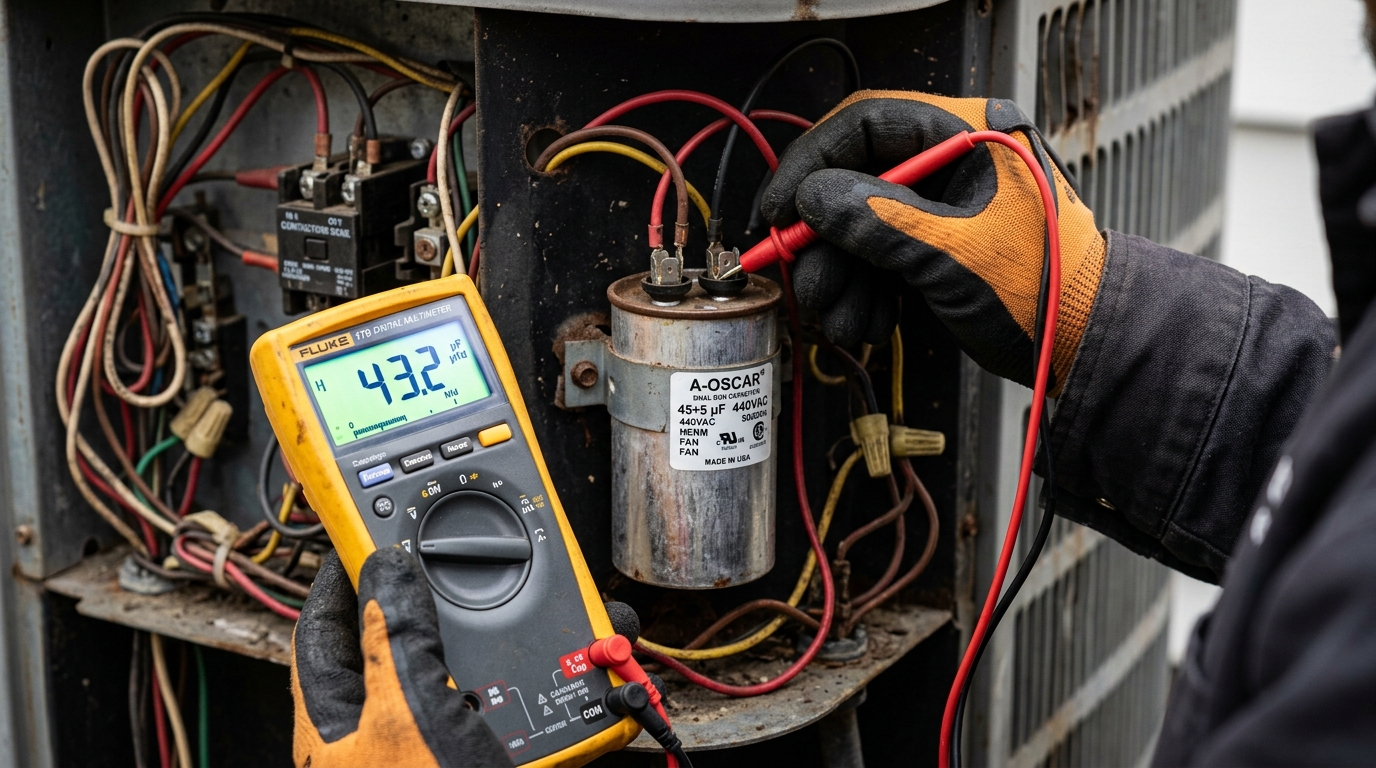
Certified HVAC technicians conduct diagnostic testing and rapid component restoration on all heating and cooling systems.
Emergency Air Conditioner Diagnostic & Refrigerant Flow Analysis
When an air conditioner blows warm air during extreme heatwaves, technicians conduct rigorous thermodynamic and electrical tests to diagnose the failure mechanism accurately. Calibrated digital gauges record suction superheat and liquid subcooling simultaneously while multimeters verify capacitor microfarads against factory tolerance standards.
Dual Run Capacitor Microfarad Testing & Replacement
Dual run capacitors supply phase shift torque to start and run outdoor compressor motors and condenser fan blades. Ambient heat exceeding 100 degrees causes internal dielectric oil breakdown, dropping capacitance below nominal ratings and causing compressors to stall under locked rotor amperage.
Technicians discharge high voltage safely, measure microfarads across HERM and FAN terminals, and install premium 440V industrial-grade capacitors in minutes.
Refrigerant Leak Detection & Electronic Halogen Sniffing
Gradual pinhole leaks along copper suction lines or aluminum evaporator coils drop system pressure, resulting in coil icing and low delta-T cooling splits. Certified technicians utilize sensitive heated diode refrigerant sniffers and ultrasonic acoustic detectors to isolate leaks without venting regulated refrigerant.
Leaks are isolated, braze repairs executed under nitrogen purge, and precision factory refrigerant trim charges weighed in using digital scales.
Transparent Emergency AC Repair Pricing Schedule
Emergency air conditioner diagnostics carry an upfront $89 service call fee that is credited directly toward completed on-site repairs. Homeowners receive an itemized breakdown of parts and labor before any mechanical work begins, ensuring zero hidden costs or emergency pricing surprises.
Typical Emergency AC Component Cost Ranges
Capacitor replacements range from $140 to $280, contactors range from $120 to $240, and thermal expansion valves range from $380 to $650 across our certified network. All installed components include full parts warranties and guaranteed operational stabilization.
Technicians test temperature splits across supply and return ducts, verifying an 18 to 22-degree drop before closing out the service ticket.
Blower Motor & Fan Assembly Replacement Pricing
ECM variable-speed blower motor replacements range from $450 to $850, while standard PSC condenser fan motors range from $280 to $480. Technicians carry universal programmed motors on service vans to avoid delays waiting for supply house orders.
New motor installations include dynamic blower cage balancing and capacitor matching to guarantee quiet, smooth mechanical operation.
Thermodynamic Performance Testing & Delta-T Airflow Split
Before concluding any emergency AC repair call, technicians perform digital psychrometric testing across return and supply plenums to confirm proper heat absorption. Supply air must measure between sixteen and twenty-two degrees cooler than return air to verify adequate refrigerant vaporization.
Liquid Subcooling vs Suction Superheat Optimization
Systems equipped with thermal expansion valves require precise subcooling charging within plus or minus one degree of manufacturer specifications. Technicians measure high-side liquid line pressure and pipe temperature to eliminate refrigerant overcharging risks.
Proper subcooling guarantees a solid column of liquid refrigerant reaches the TXV inlet, maximizing cooling capacity during peak afternoon heatwaves.
Attic Ductwork Static Pressure Verification
Technicians measure total external static pressure with digital dual-port manometers across indoor air handlers. High static pressure exceeding 0.8 inches water column indicates restricted filter grilles or crushed flexible ductwork that chokes system airflow.
Balancing supply airflow prevents evaporator coil freeze-ups and extends compressor motor operating lifespan significantly.
Emergency Diagnostic Benchmark Cost Schedule
Transparent emergency pricing protects homeowners from unexpected billing surprises during high-stress heating and air conditioning failures. All physical repairs include our upfront $89 diagnostic fee credit, full one-year parts warranties, and written estimates before work begins.
| Emergency Repair Component | Diagnostic Verification Method | Benchmark Cost Range |
|---|---|---|
| Diagnostic Evaluation & Safety Check | System failure, short-cycling, electrical check | $89 (Credited toward repair) |
| Dual Run Capacitor (440V Heavy-Duty) | HERM terminal microfarad drop below ±6% | $140 to $280 |
| Contactor & High-Voltage Relay | Pitted contact points, electrical micro-arcing | $120 to $240 |
| Condensate P-Trap Nitrogen Flush | Algae zoogleal slime blockage, pan overflow | $95 to $260 |
| Thermal Expansion Valve (TXV) Replacement | Liquid line subcooling elevation, starvation | $380 to $650 |
| ECM Blower Motor & Fan Assembly | Static pressure restriction, motor winding burnout | $450 to $850 |
Interactive Emergency Diagnostic & Cost Estimator
Our interactive HVAC diagnostic engine calculates real-time repair cost ranges, component failure probabilities, and mechanical urgency thresholds based on empirical field telemetry and ACCA diagnostic standards. Select active equipment symptoms or enter your postal ZIP code for instantaneous local technician dispatch triage.
Select your active system symptom for instant component analysis and benchmark estimates.
Frequently Asked Questions
Direct answers to critical questions regarding response times, equipment safety, diagnostic fees, and professional repair standards. Certified technicians are available around the clock to address residential and commercial climate emergencies.
Why is my outdoor AC fan spinning but the air inside is warm?
A spinning condenser fan with warm indoor air indicates that the compressor is not running, usually caused by a failed dual run capacitor on the HERM terminal. The fan motor runs on a separate circuit while the compressor sits stalled and overheating.
Is it safe to leave the AC running if it is blowing warm air?
No, you must turn the thermostat to OFF immediately. Leaving the system on forces the compressor to repeatedly attempt starting under locked rotor amperage, tripping thermal overload switches and potentially burning out the motor windings permanently.
How long does an emergency AC repair visit typically take?
Most emergency AC repairs, including capacitor replacements, contactor swaps, and drain line unclogging, are completed within 45 to 90 minutes of technician arrival on-site. Major repairs like compressor or coil replacements may take 2 to 4 hours.